

Pilates and Sports Performance Improvement: Cross-border Auxiliary Training, Breaking Sports Bottlenecks
Whether it is running, basketball, tennis or swimming, athletes often face bottlenecks such as "stagnant sports performance" and "easy injury" in long-term training. As a "cross-border auxiliary training method", Pilates can improve sports performance from three dimensions: core stability, body coordination, and muscle control, helping athletes break through bottlenecks while reducing the risk of sports injuries, and has become a "secret training weapon" for many professional athletes.
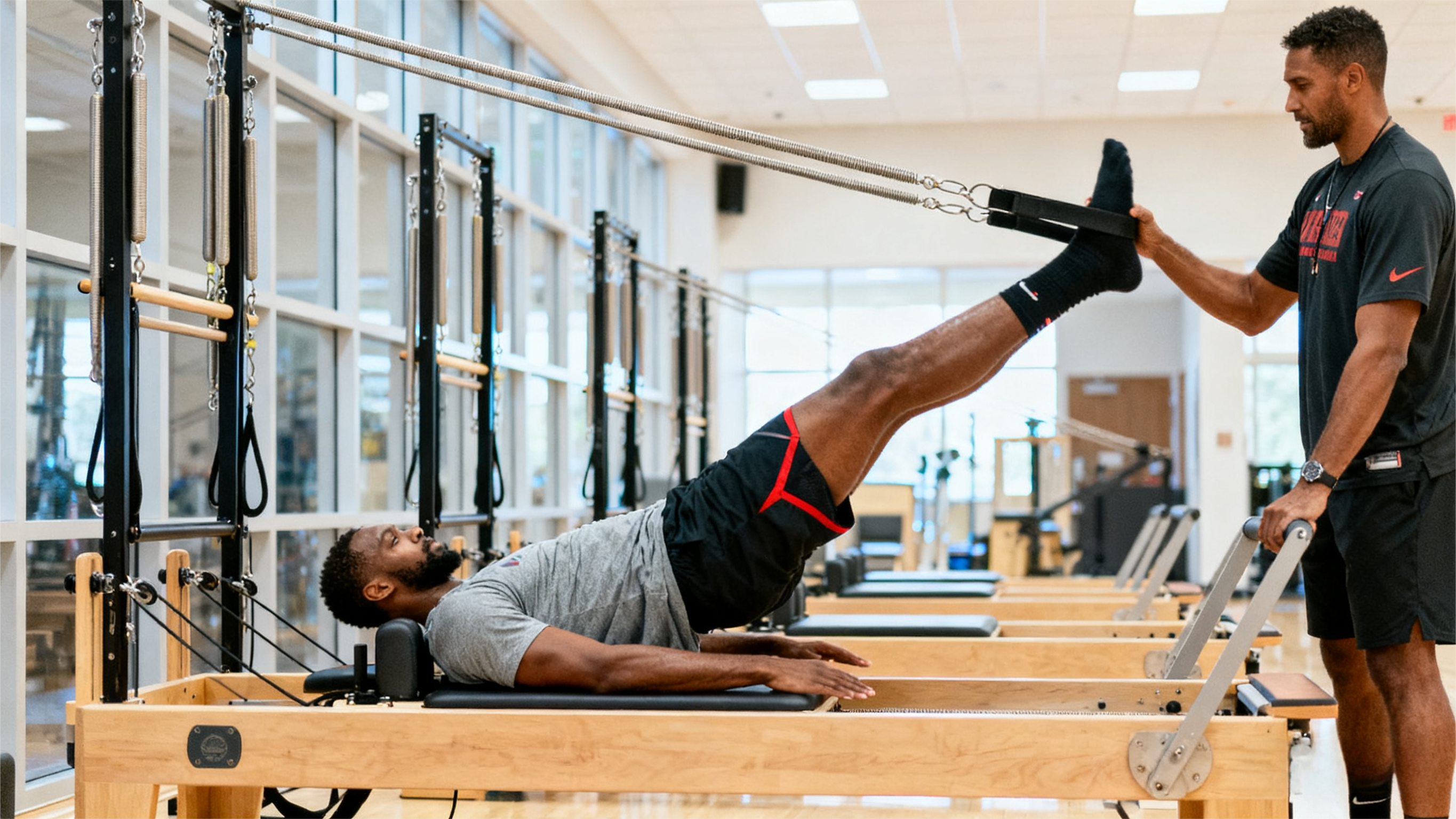
The core role of Pilates in improving sports performance lies in "strengthening the deep core and enhancing sports stability". Almost all sports rely on the support of core muscles - core stability during running can reduce body shaking and save energy; core force during basketball jumps can increase jump height; core rotation during tennis swings can enhance hitting power. Pilates activates deep core muscles such as the transverse abdominis and multifidus through "precision core training", rather than simply exercising superficial muscles. For example, the advanced version of "Pilates Hundreds": the practitioner lies flat, lifts the legs to 45 degrees from the ground, quickly taps the legs with hands, while keeping the core tight to avoid waist compensation. This movement can continuously strengthen core endurance, allowing athletes to maintain a stable posture during long-term sports (such as marathons, football matches) and reduce movement deformation caused by core fatigue. Studies have shown that runners who received 8 weeks of Pilates core training had a 20% reduction in body shaking during running, a 15% increase in endurance, and an average pace improvement of 10 seconds per kilometer.
Secondly, Pilates can "improve body coordination and enhance movement precision". Many sports have high requirements for movement coordination - swimming requires precise coordination of hands, feet and breathing, and tennis requires coordinated force of all body muscles to complete a swing. Pilates improves body coordination through "multi-joint linkage training", such as "standing resistance band rotation": the practitioner stands with feet shoulder-width apart, holds both ends of the resistance band with hands, inhales to prepare, exhales to slowly rotate the body to one side, while stretching the resistance band, feeling the coordinated force of all body muscles, 10 times per side. This movement can train trunk rotation coordination and improve the movement fluency of rotational sports such as tennis and golf; another example is "single-leg balance ball passing": the practitioner stands on one leg, holds a soft ball, and slowly passes the ball to different parts of the body (such as from hand to foot, from front to back), which can not only improve balance ability but also enhance hand-eye coordination, suitable for athletes of ball sports such as basketball and volleyball.
In addition, Pilates can "correct muscle imbalance and reduce the risk of sports injuries". Athletes often suffer from muscle imbalance due to long-term single sports - runners are prone to tight front thighs and weak back thighs, while basketball players are prone to tight shoulder flexion muscles and weak extension muscles. These imbalances are the main causes of sports injuries. Pilates improves muscle balance through "targeted stretching and strengthening": for runners, "calf back stretching" (standing against the wall, straightening the back leg to feel calf stretching) and "thigh back strengthening" (lying prone, slowly lifting the calf to activate the hamstrings) are recommended; for basketball players, "shoulder extension training" (fixing the resistance band behind the body, pulling the resistance band with hands to activate the posterior shoulder rotator cuff muscles) and "chest stretching" (doorway stretching to relieve chest muscle tension) are recommended. By balancing muscle strength, athletes can reduce muscle compensation during sports and lower the risk of injuries such as tendinitis and muscle strains.
Pilates training plans for athletes of different sports need to be "accurately adapted to the characteristics of the sport": runners focus on strengthening core endurance and lower limb flexibility; ball sport athletes focus on balance coordination and joint stability; swimmers need to improve trunk rotation force and breathing control. It is recommended that athletes conduct Pilates training 2-3 times a week before the season, and adjust to 1-2 times a week during the season to avoid overtraining; at the same time, communicate with the professional coach to ensure that Pilates training is consistent with the professional training goals, forming an efficient training mode of "professional training + Pilates assistance".
Today, more and more professional sports teams (such as NBA teams, marathon national teams) have incorporated Pilates into their daily training systems, and ordinary sports enthusiasts can also improve their sports performance through Pilates and enjoy the fun brought by sports. Pilates is no longer a "single fitness method", but an "all-round auxiliary training" that helps various sports break through bottlenecks.