

Pilates and Teen Sports Ability Development: Enhance Coordination and Explosiveness, Support Growth
Adolescence is a critical stage for sports ability development. Good coordination, explosiveness, and core stability not only improve performance in specialized sports such as ball games and track and field but also lay the foundation for lifelong sports habits. Through "interesting and targeted" training design, Pilates avoids high-intensity impact movements, protecting the development of adolescents' joints while accurately enhancing core sports abilities, making it a scientific auxiliary method for adolescents' sports ability development.
The primary role of Pilates in improving adolescents' sports ability is to "strengthen core stability and enhance movement control precision". The core muscle group is the "power hub" for adolescents to complete movements such as running, jumping, and throwing. A weak core easily leads to movement deformation (e.g., body shaking while running, posture deviation while shooting a basketball). It is recommended that adolescents start training with "four-point support alternate leg lift": kneel on hands and knees, keep the back straight, inhale to stabilize the body, exhale to slowly lift one hand and the opposite leg (in a "diagonal" posture), hold for 3-4 seconds, then return to the original position, 8 times per side, 2-3 sets per session. This movement activates the deep core muscles of the waist and abdomen, improves body balance and control ability, and avoids movement deviations caused by weak core during sports. Many adolescents participating in training report that after 1 month of persistence, their bodies are more stable when dribbling a basketball, their stride is more even when running, and movement coherence is significantly improved.
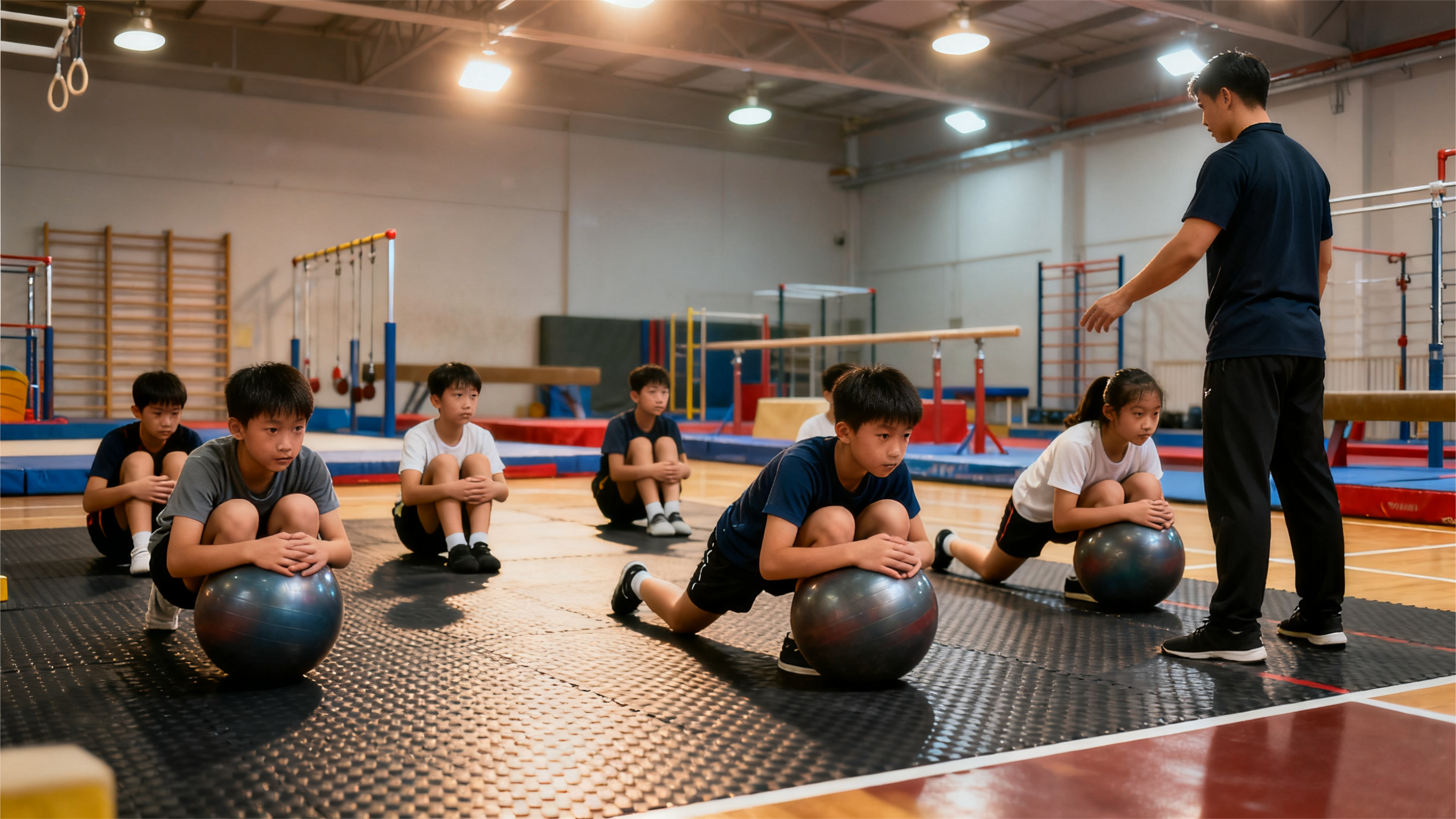
Secondly, Pilates can "improve body coordination and connect sports nerve responses". Poor performance of adolescents in specialized sports is often due to "uncoordinated hands and feet" and "slow body reactions" - such as disjointed hand-foot rhythm when passing a football, and insufficient coordination between the trunk and arms when swinging a tennis racket. Pilates improves coordination through "interesting multi-joint linkage training", such as "Pilates ball throwing and catching training": adolescents stand, hold a small ball with both hands, inhale to throw the ball upward, exhale to quickly squat and stand up to catch the ball, while 配合 slight leg jumps; or "side-lying ball rolling": lie on the side with knees bent, clamp the ball between the legs, slowly roll the ball to the ankle and pull it back, feeling the coordinated force of the lateral chain muscles. This kind of training integrated with "game elements" allows adolescents to improve hand-eye coordination and the coordination between the trunk and limbs in a fun way, and the training effect is more than 50% better than traditional boring coordination exercises.
In addition, Pilates can "gently enhance explosiveness and protect joint development". Adolescents are in the stage of joint cartilage development. Excessive weight-bearing or high-intensity jumping can easily damage the knee and ankle joints. Pilates activates fast muscle fibers under low impact through "elastic force training". For example, "standing resistance band leg push": adolescents step on both ends of the resistance band with their feet, hold the middle of the resistance band with their hands, inhale to bend the knees and squat halfway, exhale to quickly push the legs straight, and at the same time stretch the resistance band upward, feeling the explosive force of the legs and the coordinated force of the arms, 10 times per set, 2 sets per day. This movement uses the controllable resistance of the resistance band to allow adolescents to practice "fast force generation" within a safe range, improving the pushing explosive force during running and jumping; another example is "mat quick crunch (low amplitude)": lie flat with knees bent, hands on both sides of the thighs, inhale to prepare, exhale to quickly contract the abdomen and lift the upper back (only 5 cm off the ground), inhale to slowly fall back, 12 times per set, training core explosiveness to help improve performance in sprinting, long jumping and other events.
Adolescent Pilates training should follow the principle of "age-appropriate adaptation": for 10-12 years old, focus on "interesting basic movements" to cultivate core perception and coordination, 20 minutes per training session, twice a week; for 13-16 years old, "resistance band and small ball-assisted advanced movements" can be added, appropriately increasing the proportion of explosiveness training, 25-30 minutes per training session, 2-3 times a week. At the same time, two misunderstandings should be avoided in training: one is blindly increasing the difficulty (such as letting adolescents do the adult version of "Hundreds"), leading to excessive muscle fatigue; the other is ignoring the fun of movements and making adolescents feel resistant to boring training - group competitions (e.g., "who can hold the diagonal support longer") and changing training tools (e.g., using colorful balls and cartoon resistance bands) can be used to improve participation.
Pilates provides a "safe and efficient" path for adolescents' sports ability development. It does not pursue high intensity but activates core sports abilities through scientific training, helping adolescents break through bottlenecks in specialized sports, while developing the habit of "perceiving the body and exercising scientifically", laying a foundation for long-term sports health.